
10 Best Voice AI Assistant Platforms for 2026 (Call Centers)
Compare the 10 best Voice AI Assistant platforms of 2026 for support, sales, and call centers. See pricing, workflows, and picks by use case.

TL;DR
Voice AI assistants have moved from flashy demos to real production workloads, but most teams struggle to pick the right platform. This guide ranks 10 platforms by production fit, not marketing polish. SigmaMind AI leads the list for teams that need workflow completion, model flexibility, and transparent pricing. If you just need the fastest no-code launch, look at Synthflow. If your engineering team wants raw primitives, Vapi is worth evaluating. For large enterprises with procurement cycles, PolyAI, Cognigy, and Rasa each serve different needs.
Why This Guide Exists
Ninety-one percent of customer service leaders are under executive pressure to implement AI, according to a February 2026 Gartner survey of 321 leaders source. The pressure is real. So is the confusion.
AI adoption across enterprise contact centers has reached 98%, but only 12% of organizations say they have fully optimized AI value source. There is an 86-percentage-point gap between deploying AI and actually getting strategic results from it. Many companies are stuck in what USAN calls “pilot purgatory,” cycling through disconnected tools that never graduate to production.
The voice AI assistant market is part of this problem. Dozens of platforms promise human-like conversation. Very few deliver reliable workflow completion at real call volume. The difference between a good demo and a good deployment is enormous, and the current crop of comparison articles barely touches it.
This guide ranks platforms by what matters after the demo ends: latency under load, workflow completion, telephony readiness, pricing transparency, observability, and clean human handoff.
What Is a Voice AI Assistant?
A voice AI assistant is a real-time AI agent that listens to spoken language, understands intent and context, responds with natural speech, calls tools and APIs, updates business systems, routes or transfers calls, and produces transcripts, summaries, and analytics. It goes beyond reading scripts or routing through menu trees.
The terminology in this space is messy. Here is how the common terms break down:
| Term | What it usually means | Limitation |
|---|---|---|
| IVR | Menu-based phone routing | Rigid, often keypad-driven |
| Voice bot | Scripted or intent-based phone automation | Narrow and brittle |
| AI voice assistant | Real-time spoken AI that can answer and act | Quality depends on orchestration |
| Voice AI agent | Action-oriented assistant with tools, state, workflows | Needs testing, guardrails, observability |
| TTS platform | Generates speech from text | Not a full phone agent platform |
| Conversational AI platform | Builds chat/voice agents across channels | Voice depth varies |
For the purposes of this article, “voice AI assistant” and “voice AI agent” refer to the same category: platforms that can handle real phone conversations, complete business tasks, and escalate to humans with context. The SigmaMind AI platform is a good reference point for what a production-grade voice AI assistant looks like in practice, combining a no-code builder with developer APIs across voice, chat, and email from a single logic layer.
Under the hood, most production voice AI assistants still use a cascaded streaming architecture: speech-to-text, then a large language model, then text-to-speech. A 2026 arXiv technical tutorial found that this pipeline remains the practical approach for self-hostable deployments, reporting 755 ms time-to-first-audio with function calling support source. End-to-end speech-to-speech models exist but are not broadly practical for production self-hosting yet.
How We Evaluated These Platforms
Every platform on this list was assessed across six dimensions. These are the criteria that separate a tool you can demo from a tool you can deploy.
1. Real-time conversation quality. Latency, barge-in handling, turn-taking, endpointing, and noise/accent tolerance. Practitioners on LinkedIn point out that the AI model is often not the bottleneck. The lag hides in “glue” like turn-taking, voice activity detection, and interruption handling source. Another practitioner focused on evaluation says end-of-turn detection is frequently the “long pole,” and recommends measuring “mouth-to-ear” turn gaps rather than isolated model timing source.
2. Workflow completion. Can the assistant actually do something, or does it just talk? Tool calls, CRM/helpdesk/calendar actions, state management, API/webhooks, and escalation logic. This is where most voice AI demos fall apart in production.
3. Telephony readiness. Inbound/outbound calling, SIP/BYOC support, phone numbers, warm transfers, and concurrency under load.
4. Pricing transparency. Platform fees, STT, TTS, LLM, telephony, transfers, add-ons, and implementation costs. A common frustration on Reddit is that headline per-minute rates hide the real bill. One commenter in a pricing discussion argued that the metric that matters is cost per qualified conversation, not raw per-minute price source.
5. Operations and observability. Logs, transcripts, recordings, cost breakdowns, QA tools, and monitoring. If you cannot see why a call failed, you cannot improve the agent.
6. Security and compliance. SOC 2, SSO, RBAC, data retention, PII handling, and industry-specific requirements.
The SigmaMind app library is worth reviewing for an example of how integrations with CRMs, helpdesks, e-commerce platforms, and calendars turn a voice AI assistant into something that actually completes tasks.
Quick Picks
- Best overall for production workflow voice AI: SigmaMind AI
- Best for voice-first call automation: Retell AI
- Best developer API for custom voice agents: Vapi
- Best for outbound and enterprise calling workflows: Bland AI
- Best no-code quick launch: Synthflow
- Best managed enterprise voice assistant: PolyAI
- Best enterprise governance and complex flows: Cognigy
- Best for voice quality and voice cloning: ElevenLabs
- Best for self-hosted / sovereign deployment: Rasa Voice
- Best for conversation design and prototyping: Voiceflow
At-a-Glance Comparison Table
| Platform | Best for | Pricing model | Build style | Key differentiator | Watch-out |
|---|---|---|---|---|---|
| SigmaMind AI | Developer-led teams, agencies, contact centers needing multi-step workflows | $0.03/min platform + provider costs; enterprise custom | No-code builder + APIs + MCP | Model-agnostic orchestration, node-based stateful workflows, BYOC/SIP, warm transfers, analytics | Direct phone-number purchase currently US-focused; international via BYO Twilio/Telnyx/SIP |
| Retell AI | Voice-first call automation | $0.07–$0.31/min for AI voice agents; enterprise custom | Visual + API | Strong phone-agent focus, analytics, call transfer, batch calling | Broader omnichannel depth is narrower than full CX suites |
| Vapi | Developers building custom voice stacks | $0.05/min Vapi call fee + provider costs | API-first | Flexible STT/TTS/LLM/telephony choices | Fragmented billing and more engineering ownership |
| Bland AI | Outbound, enterprise calling, scripted call paths | Start free at $0.14/min; Build $299 + $0.12/min; Scale $499 + $0.11/min | API + pathways | Conversational pathways, batch calls, guardrails, memory | Transfer fees and plan-based minute rates need modeling |
| Synthflow | SMBs/agencies wanting no-code launch | PAYG $0/month; roughly $0.15–$0.24/min | No-code | Fast visual setup, agency/subaccount workflows | Less ideal for complex custom logic or deep engineering control |
| PolyAI | Large enterprise contact centers | Custom per-minute; managed service | Managed enterprise | Human-like voice assistants, 24/7 support, SLA, security | Enterprise sales cycle; no public numeric rates |
| Cognigy | Enterprise conversational AI at scale | Enterprise custom | Low-code enterprise platform | Governance, integrations, complex dialog flows, stability | Learning curve and implementation complexity |
| ElevenLabs | Voice quality and cloning | Free 15 min; Starter $5/50 min; Pro $99/1,100 min; LLM pass-through | Voice/agent platform + API | Best-in-class synthetic voice quality | Not the strongest full contact-center orchestration layer |
| Rasa Voice | Regulated enterprises needing self-hosting | Free Developer Edition; Enterprise custom | Pro-code + enterprise | Self-hosting, control over stack, custom ASR/TTS | Requires technical team; not the fastest self-serve launch |
| Voiceflow | Conversation design and collaborative prototyping | Usage-based credits; tiers from free to enterprise | Visual builder | Strong flow design, collaboration, multi-channel agent design | Production telephony depth and pricing clarity can be limited |
The 10 Best Voice AI Assistant Platforms
1. SigmaMind AI

Best for: Developer-led teams, agencies, and contact centers that need voice AI assistants to complete multi-step business workflows, not just hold conversations.
Pricing:
- Voice agents: $0.03/min platform fee + provider costs for STT, TTS, LLMs, and telephony
- Chat agents: $0.005 per AI message platform fee + LLM and optional SMS add-on costs
- Enterprise: custom, volume-based pricing
- Free start: build for free, pay only for what you use
- Estimate your costs with the pricing calculator
Key features:
- No-code agent builder for multi-step conversational flows with branching, variables, waits, escalation logic, and tool/API actions
- Single-prompt agent creation for fast prototyping
- In-builder playground with node-level logs for testing and debugging
- Model-agnostic stack: Deepgram STT, ElevenLabs/Rime/Cartesia TTS, OpenAI/Claude/Gemini/Hume AI LLMs
- Built-in telephony with Twilio, Telnyx, SIP, and BYOC support
- Warm transfer with structured context headers so human agents get summaries and machine-readable data
- Function/tool calling and an app library connecting CRMs, helpdesks, e-commerce platforms, calendars, and spreadsheets
- Voice, chat, and email from one logic layer
- Analytics and cost breakdowns by layer
- Outbound campaigns with CSV upload, scheduling, concurrency caps, and personalization variables
- Multi-workspace and full-agent import for agencies/BPOs
What users and proof points say:
- 1M+ calls handled, 1,500+ live agents, approximately 970 ms average voice latency (homepage telemetry)
- Case study: 4,000+ refunds/month automated with 43% cost savings, turnaround reduced to under 60 seconds (read the full case study)
- Gardencup case study: 80% reduction in refund processing time, 20% CSAT lift, resolution time from 15 hours to 1 hour
- CleanBoss case study: 50% reduction in first response time, 30% reduction in resolution time, 15% CSAT lift in 3 months
- YC-backed; Product Hunt launch with 4.9 rating from 14 reviews
Tradeoffs:
- Direct phone-number purchase is currently US-only. International deployments require BYO carriers via SIP/Twilio/Telnyx.
- Modular pricing is transparent but requires modeling STT, TTS, LLM, telephony, and add-ons to arrive at a total cost.
- Depends on third-party AI providers for STT/TTS/LLM, so quality and economics can shift with vendor changes.
- Claims SOC 2 and HIPAA-friendly workflows, but is not HIPAA compliant yet. Healthcare buyers should review BAAs, data flows, and private-cloud options before committing.
Bottom line: SigmaMind AI is the strongest overall pick for teams that want a voice AI assistant capable of completing real work across real call flows. The combination of no-code building, developer APIs with MCP support, model/provider flexibility, telephony integrations, and layered analytics hits the gaps that most competing platforms leave open.
2. Retell AI

Best for: Teams that want a voice-first phone-agent platform with strong call quality and pay-as-you-go pricing.
Pricing:
- Pay-as-you-go: $0.07–$0.31/min for AI voice agents source
- Chat agents: $0.002+/message
- $10 in free credits
- 20 included concurrent calls
- Enterprise: custom pricing
- Component pricing for telephony, TTS, LLMs, phone numbers, knowledge bases, and extra concurrency
Key features:
- Voice AI agents for inbound and outbound calls
- Call transfer and appointment booking
- Knowledge base integration
- IVR navigation
- Batch calls and branded caller ID
- Post-call analysis, webhooks, and API access
- Simulation testing, analytics, and transcripts
What users say:
Practitioners on Reddit who compare Retell, Vapi, and Bland often describe Retell as feeling smoother in messy back-and-forth calls, while Vapi gives more developer control and Bland leans enterprise/outbound source. Retell’s own roundup article cites G2-style sentiment around call quality and production readiness.
Tradeoffs:
- Strong in voice, but not the best fit if you need one orchestration layer across voice, chat, email, and complex multi-node workflows.
- May still require significant technical work for integrations, data access, and production workflows.
- Pricing must be modeled by component. The advertised per-minute range is not all-in.
Bottom line: Retell is a strong voice-first alternative, particularly for teams focused primarily on phone automation. SigmaMind offers broader workflow orchestration and multi-channel coverage for teams that need more than call handling.
3. Vapi

Best for: Engineering teams building custom voice products who want to choose their own STT, TTS, LLM, and telephony stack.
Pricing:
- Vapi platform fee: $0.05/min for calls source
- Provider costs (transcription, model, voice, telephony) billed separately
- Average voice-agent conversation estimated around $0.15/min in some overviews
Key features:
- API-first voice agents
- Bring-your-own model/provider approach
- Custom STT/TTS/LLM stack choices
- Telephony integrations
- Function calling and custom workflows
- Developer-centric logging and configuration
What users say:
Reddit users often describe Vapi as flexible and developer-friendly but requiring more setup. One comparison thread notes Vapi is useful for custom logic and integrations, but latency can be noticeable depending on configuration source. A Vapi subreddit discussion notes that users can reduce costs by bringing their own API keys for individual providers.
Tradeoffs:
- Higher engineering burden than platforms with guided builders.
- Costs are fragmented across several layers and hard to predict upfront.
- Less ideal for non-technical teams that want a no-code builder and operations dashboard.
- Production quality depends heavily on how the stack is configured.
Bottom line: Vapi is excellent if your team wants a voice API and has engineers to own the stack. SigmaMind is the better path if you want developer control and a higher-level workflow builder, testing environment, analytics, and agency/contact-center features in one place.
4. Bland AI

Best for: High-volume outbound campaigns and enterprise calling workflows with structured conversational paths.
Pricing (effective December 5, 2025):
- Start: free plan, $0.14/min
- Build: $299/month + $0.12/min
- Scale: $499/month + $0.11/min
- Transfer time: $0.05/min, $0.04/min, and $0.03/min by plan
- SMS: $0.02/message
- BYOT customers may avoid some Bland transfer fees source
Key features:
- Conversational Pathways for structured call logic
- Batch calls and call logs
- Custom Twilio integration and webhooks
- Tools and custom API integrations
- Guardrails and memory
- Testbed and scenarios
- Warm transfer and SIP integration
- SSO support for enterprise contexts
What users say:
Reddit comparisons often describe Bland as strong for enterprise features and control, but sometimes less natural sounding, described as “too polished” compared with more conversational platforms. These observations are anecdotal but reflect common buyer language in the space.
Tradeoffs:
- Pricing increased from a prior flat $0.09/min to plan-based rates, so older comparisons are outdated.
- Transfers and telephony can add complexity and cost.
- May be more than SMBs need for simple reception or appointment booking.
- Buyers should model transferred-call billing, failed-call minimums, and BYOT implications carefully.
Bottom line: Bland is a serious outbound and enterprise call platform. SigmaMind offers more flexibility for multi-step workflows, model/provider choice, and omnichannel orchestration.
5. Synthflow

Best for: SMBs and agencies wanting to deploy an AI receptionist or basic call assistant quickly without engineering resources.
Pricing:
- Pay As You Go: $0/month, with call billing based on LLM plus voice engine, roughly $0.15–$0.24/min source
- Synthflow Voice Engine: $0.09/min on PAYG, plus LLM rates
- Enterprise: custom, for teams handling 10,000+ minutes/month
Key features:
- No-code visual builder
- Phone call agents for inbound and outbound
- CRM and webhook automations
- Knowledge bases and voice previews
- Agency/subaccount usage management
- Usage dashboard
- Community and ticketing support on PAYG; enterprise SLA available
What users say:
Synthflow publicly emphasizes latency improvements, claiming a 40% reduction in voice AI latency with cleaner turn-taking and fewer interruptions. User sentiment from competitor roundups points to strong ease of use and fast setup, with some cost sensitivity at scale.
Tradeoffs:
- Less ideal for deep custom telephony logic or complex routing.
- No-code speed becomes a constraint when workflows require granular state, branching, and debugging.
- Higher-volume teams need to model usage carefully.
Bottom line: Synthflow is a good “fast no-code” choice. For teams that need no-code plus developer-grade APIs, deeper debugging, multi-client workspaces, and complex workflow orchestration, SigmaMind is the stronger pick. If you want to see how a more advanced no-code agent builder handles multi-step flows, SigmaMind’s builder is worth exploring.
6. PolyAI

Best for: Large enterprise contact centers that want a fully managed voice assistant with SLAs, 24/7 support, and security infrastructure included.
Pricing:
- Per-minute basis for ongoing use, includes proactive performance improvements, maintenance, 24/7 support, security, SLA, monitoring, and upgrades
- No public numeric rates; enterprise sales cycle required
Key features:
- Enterprise voice assistants purpose-built for high call volume
- 24/7/365 emergency support phone line
- Security and compliance infrastructure
- 99.9% SLA for uptime on phone lines
- Monitoring and performance improvement
- Maintenance and upgrades
- Multilingual support
What users say:
PolyAI holds a 5.0/5 rating from 12 reviews on G2. Users praise human-like voice, ease of integration, effective call automation, and responsive support. Some note occasional slowness and the broader challenge of public acceptance of AI voice assistants source.
Tradeoffs:
- Not ideal for teams wanting self-serve signup and transparent numeric pricing.
- More managed-service oriented, which means less granular control for developers.
- Longer procurement and implementation timeline.
- Less suited to developer teams that want model/provider flexibility.
Bottom line: PolyAI is a strong option for large enterprises that want a managed voice AI assistant. SigmaMind is better for teams that want to build faster, choose their own models and providers, and control costs transparently.
7. Cognigy
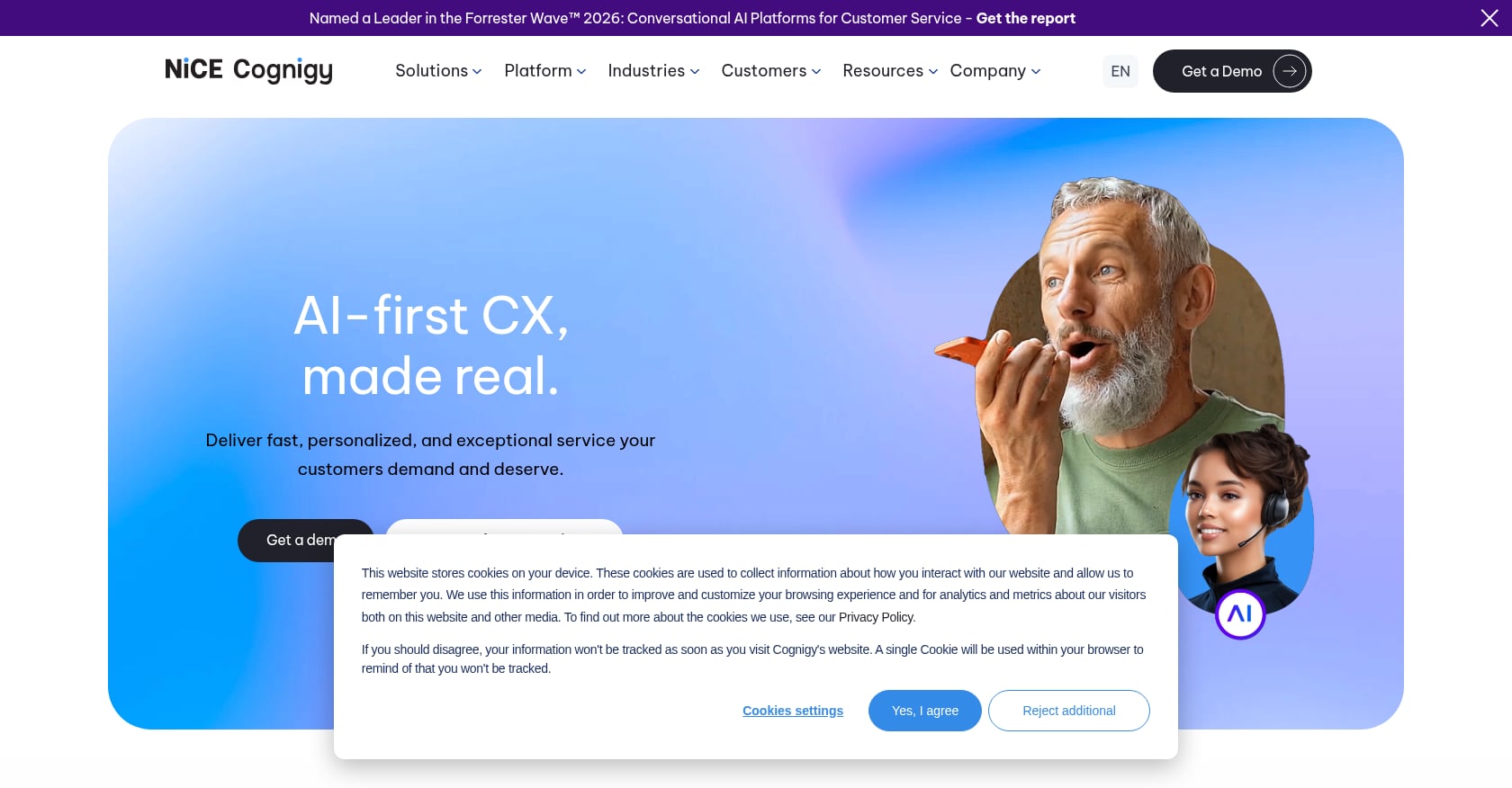
Best for: Large enterprises in regulated industries that need governance, complex dialog flows, and deep integrations across existing contact-center infrastructure.
Pricing:
- Enterprise custom pricing
- Capterra listing shows a 4.8 rating from 22 reviews
Key features:
- Enterprise dialog and flow management
- Voice and chat channels
- Contact-center and CRM/backend integrations
- Agent assist use cases
- Governance and analytics
- Multilingual service
- Low-code/no-code interface for enterprise teams
What users say:
Gartner Peer Insights rates Cognigy.AI Platform at 4.8 from 139 ratings. Review summaries praise enterprise-grade conversational design, complex dialog flows, integration capabilities, scalable architecture, stability, and flexibility. Downsides include a steep learning curve, need for technical expertise, and complexity around analytics configuration and global rollouts source.
Tradeoffs:
- Heavyweight compared with voice-native platforms.
- Requires significant implementation resources.
- Slower iteration cycle than lighter builders.
- Better suited for mature enterprises than startups or SMBs.
Bottom line: Cognigy is the enterprise governance option. It should not be the default for teams that want to build and iterate quickly.
8. ElevenLabs
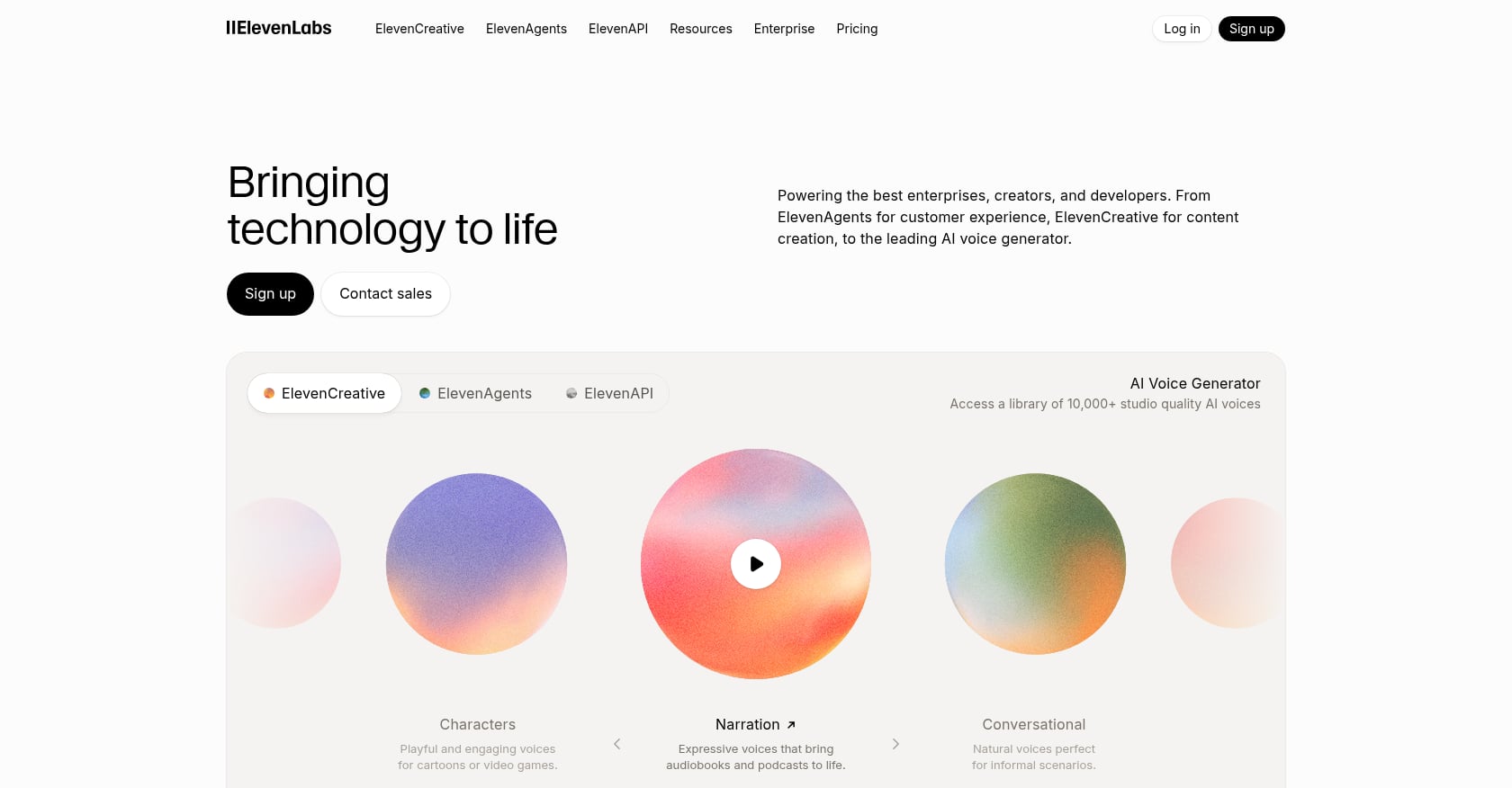
Best for: Teams where realistic voice quality, voice cloning, and natural speech are the primary priority.
Pricing:
- Free: $0, 15 minutes
- Starter: $5, 50 minutes
- Creator: $22, 250 minutes
- Pro: $99, 1,100 minutes
- Scale: $330, 3,600 minutes
- Business: $1,320, 13,750 minutes
- LLM costs passed through separately source
Key features:
- High-quality text-to-speech
- Voice cloning and voice design
- Conversational AI agents
- Real-time speech-to-text
- Voice isolator and voice changer
- API access
- Multimodal and text-only agent pricing options
What users say:
G2 shows ElevenLabs at 4.5/5 from 1,126 reviews. Users praise realistic voice quality, ease of use, and quick setup. Some mention high pricing, missing features, and pronunciation issues source. Reddit users frequently praise ElevenLabs voice quality but raise latency and cost questions for conversational agent use cases.
Tradeoffs:
- Excellent voice layer, but not the strongest full orchestration platform for contact-center workflows.
- LLM pass-through costs mean the subscription price is not the full cost.
- Voice quality alone does not solve workflow completion, observability, human handoff, or telephony depth.
Bottom line: ElevenLabs is a top voice-quality choice. For teams that need to orchestrate multiple providers, workflows, and telephony while using best-in-class TTS, SigmaMind can integrate ElevenLabs as a TTS provider within its model-agnostic stack.
9. Rasa Voice
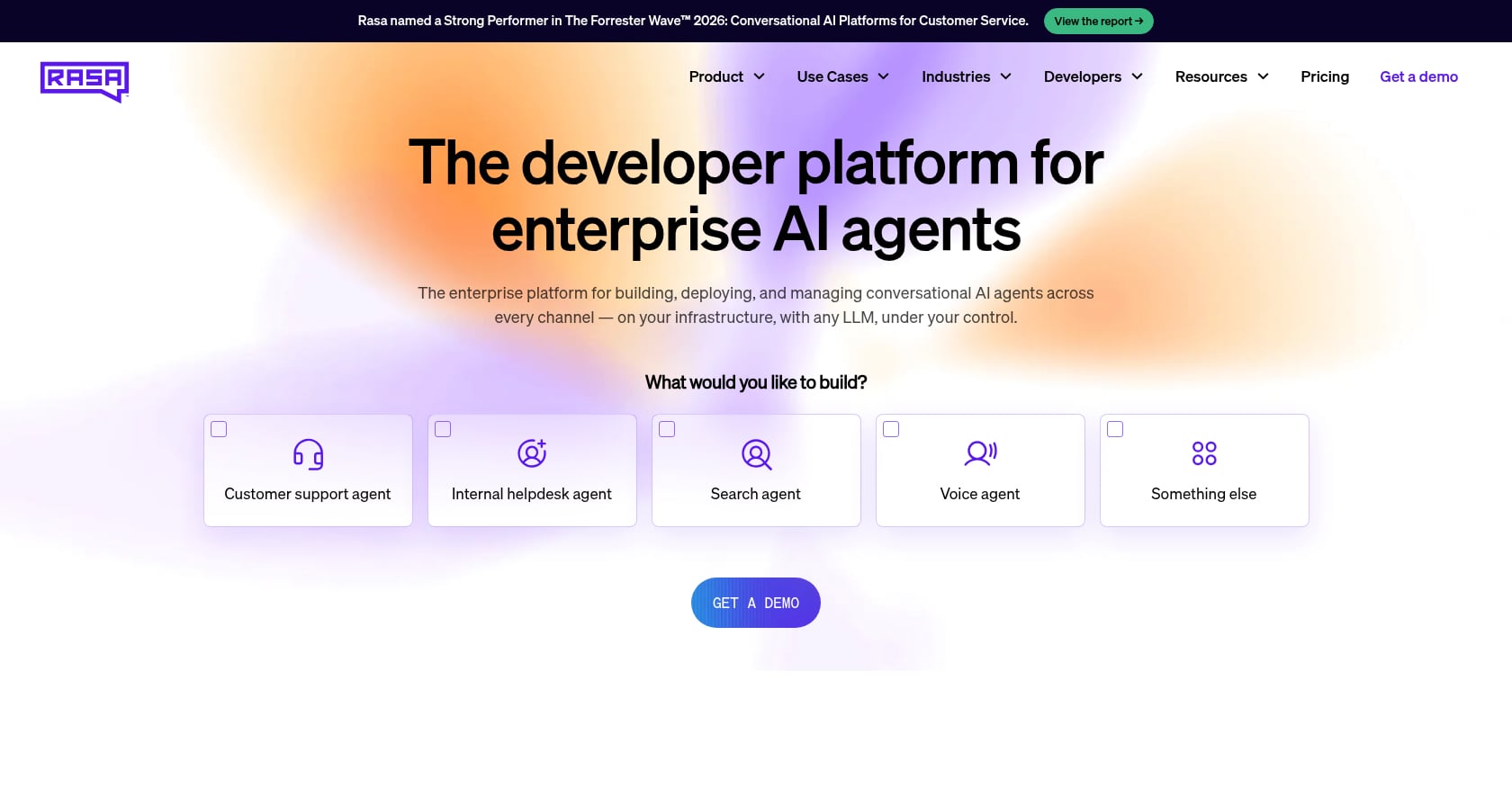
Best for: Regulated enterprises (financial services, healthcare, government, telecom) that need self-hosted or private-cloud deployment and full control over architecture and data.
Pricing:
- Free Developer Edition: one bot per company, up to 1,000 external conversations/month
- Enterprise: contact sales for full platform access and premium support source
Key features:
- Rasa Pro framework with CALM dialogue management
- Rasa Studio no-code UI
- Enterprise search and custom actions
- Channel connectors and voice deployment
- Kubernetes deployment
- PII data management
- LLM fine-tuning recipe and multi-LLM management
- Observability via OpenTelemetry
- Self-managed or managed deployment
What users say:
G2 shows Rasa at 4.0/5 from 11 reviews. Users praise customizability and the open-source nature, but note complexity for beginners and documentation gaps source.
Tradeoffs:
- Requires more technical skill than most alternatives.
- Not the easiest choice for fast no-code launch.
- Enterprise pricing is custom and opaque.
- Better for teams that need ownership and control than teams wanting a quick AI receptionist.
Bottom line: Rasa is the sovereign deployment option. SigmaMind is better for teams that want faster deployment with a no-code builder, APIs, telephony integrations, and model/provider flexibility without the self-hosting overhead.
10. Voiceflow

Best for: Conversation designers and CX teams building structured assistant flows across channels with strong collaboration tools.
Pricing:
- Usage-based billing powered by credits (covering chat messages, LLM calls, voice minutes, and orchestration)
- Third-party analysis describes tiers from Starter/free through Pro ($60/month), Business ($150/month), and Enterprise custom, though buyers should verify current pricing directly
- Reddit threads indicate pricing clarity is a common buyer question source
Key features:
- Visual agent builder with collaboration tools
- Agent observability with development, staging, and production environments
- Integrations with Zendesk, Salesforce, Airtable, Shopify, HubSpot, Make, Gmail
- Voice and chat deployment
- Model-provider flexibility
What users say:
Users appreciate Voiceflow as a design and prototyping environment. The recurring concern in forums is pricing clarity, with several Reddit discussions asking how costs scale with usage.
Tradeoffs:
- Better as a conversation design and agent-building environment than a purpose-built call-center voice automation platform.
- Voice deployment cost depends on credits, models, and telephony setup.
- Buyers needing deep telephony, SIP/BYOC, call-center analytics, and production voice operations should compare carefully.
Bottom line: Voiceflow belongs in the list for design-focused teams. It is not the right choice for production-grade voice workflow orchestration at scale.
How Much Does a Voice AI Assistant Cost?
This is the section most buyer guides skip or handle poorly. The honest answer: voice AI assistant pricing is layered, and headline per-minute rates almost never reflect total cost.
Here is the real formula:
Total cost = platform fee + STT + TTS + LLM + telephony + phone numbers + concurrency + transfer time + SMS + knowledge base/RAG + recording/transcription storage + add-ons (denoising, PII redaction, QA) + implementation and support.
Some examples of how this plays out:
- Vapi charges $0.05/min for calls, with provider costs routed separately source
- Retell shows detailed component pricing across voice infrastructure, TTS, LLMs, telephony, add-ons, and phone numbers source
- Bland charges different connected-minute and transfer-time rates depending on which plan you are on, with minimum charges for certain outbound and failed calls source
- ElevenLabs passes through LLM costs separately from the agent minutes included in each subscription tier source
SigmaMind AI takes a modular approach: a $0.03/min platform fee plus transparent provider costs for each layer. This makes it easier to model and optimize, because you can see exactly where your money goes. Use the SigmaMind pricing calculator to estimate your total cost based on your expected volume and provider choices.
The more important shift, though, is how you measure cost. Practitioners on Reddit argue convincingly that the metric that matters is cost per completed workflow, not cost per minute. A $0.10/min call that books an appointment is cheaper than a $0.05/min call that loops and fails. Measure cost per qualified lead, cost per appointment booked, cost per refund processed, or cost per contained support call.
How to Choose the Right Voice AI Assistant
Different teams need different things. Here is a decision framework:
| If you need… | Choose… |
|---|---|
| Multi-step workflow completion, model choice, BYOC, APIs, and no-code builder | SigmaMind AI |
| Voice-first phone automation with pay-as-you-go pricing | Retell AI |
| Maximum developer control and custom stack | Vapi |
| Enterprise outbound call workflows | Bland AI |
| Fast no-code setup without engineering | Synthflow |
| Managed enterprise voice assistant with SLAs | PolyAI |
| Enterprise conversational AI governance | Cognigy |
| Best synthetic voice quality | ElevenLabs |
| Self-hosted or sovereign deployment | Rasa |
| Conversation design and prototyping | Voiceflow |
McKinsey’s 2026 customer-care research found that top-quartile leaders integrate AI across operations and view contact centers as strategic profit engines. Sixty-seven percent of leaders have scaled foundational AI use cases versus 16% of laggards, and 40% of leaders reported significantly improved CX scores versus 12% of laggards source. The takeaway: treating your voice AI assistant as a point solution instead of an operations platform is a recipe for pilot purgatory.
For teams automating customer support, the right voice AI assistant should handle routine inquiries like order status and refund eligibility while escalating complex or emotional cases to human agents with full context.
Pilot Checklist Before You Buy
Do not roll out a voice AI assistant across your entire call volume on day one. Start with a focused 4-week pilot using real callers.
Step 1: Pick one high-volume, repeatable call type. Good starting points:
- Appointment scheduling (see how AI appointment scheduling works in practice)
- Order status
- Refund eligibility
- Payment reminders
- Lead qualification
- After-hours intake
- Call routing with summary
Reddit practitioners consistently say voice agents work best when focused on one simple job. Attempts to make them handle everything often lead to confused loops source.
Step 2: Define success before launch. What does “working” mean? A containment rate? A booking rate? A CSAT score?
Step 3: Use real call traffic. Rasa’s guide recommends routing real callers, not just scripted tests, and tracking performance over at least four weeks source.
Step 4: Measure what matters.
- Completion rate
- Containment rate
- Transfer rate
- Escalation quality (did the human agent get useful context?)
- Time to first meaningful action
- Abandonment rate
- Average latency
- Barge-in success
- Tool-call success
- Cost per completed workflow
- CSAT or post-call survey
Step 5: Review transcripts and failure cases weekly. SigmaMind’s analytics dashboard breaks down cost, transfers, tool calls, and call quality metrics to make this review practical.
Step 6: Expand only after the agent completes work reliably. Then add the next call type.
Common Mistakes When Buying Voice AI Assistants
Buying the best demo voice. A voice AI assistant can sound perfectly human and still fail if it cannot check live data, follow policy, call tools, or handle interruptions. ElevenLabs reviewers on G2 praise realistic voice quality but also mention cost and pronunciation issues, which shows that voice realism alone does not solve production needs source. The better criterion is workflow completion.
Ignoring transfer quality. If the human agent does not get a summary and structured data when the AI hands off, the customer repeats themselves. Warm transfer with context headers is not optional for a good experience.
Comparing only per-minute cost. A $0.03/min platform fee means nothing if the total bill is $0.25/min after STT, TTS, LLM, and telephony. Always model total cost. And compare cost per completed job, not cost per minute.
Not testing at peak concurrency. A one-call demo does not prove Friday-evening call volume. Ask vendors for latency benchmarks under real concurrency.
Giving the agent too broad a scope. Another Reddit thread puts it bluntly: the real unlock was not natural conversation alone, but giving the voice agent live order data and a focused task source. Start narrow and expand.
Weak observability. If the team cannot see why a call failed, it cannot improve the agent. Insist on transcripts, node-level logs, and cost breakdowns by layer.
What About Human Agents?
Voice AI assistants are not replacing human agents. They are changing what human agents do.
USAN’s 2026 report found that human agents report a 61% increase in difficult, high-stakes interactions as AI automates routine tasks source. Gartner similarly says AI and human expertise must work in tandem, with human agents providing context, empathy, and judgment source.
The best voice AI assistant platforms account for this. They automate repeatable call types and escalate complex or emotional cases with full context. The goal is not zero human agents. It is fewer wasted human hours on tasks a machine can handle, so your people can focus on the calls that actually need a person.
Get Started
For most teams comparing voice AI assistants in 2026, SigmaMind AI is the right starting point. It covers the widest set of production needs: no-code building, developer APIs with MCP, model/provider flexibility across STT, TTS, and LLMs, built-in telephony with SIP and BYOC, warm transfers with context, outbound campaigns, multi-workspace agency support, and layered analytics.
FAQs
What is the best voice AI assistant for business?
SigmaMind AI is the strongest overall choice for teams that need production workflow automation across support, sales, and call centers. For specific use cases, Retell is strong for voice-first call automation, Vapi for developer-built custom stacks, and PolyAI or Cognigy for large enterprise managed deployments.
What is the difference between a voice AI assistant and an AI voice agent?
The terms overlap significantly. “Voice AI assistant” tends to emphasize conversational interaction, while “voice AI agent” emphasizes action-taking and tool use (booking appointments, issuing refunds, updating CRM records). In practice, most modern platforms combine both capabilities.
How much does a voice AI assistant cost?
Total cost includes platform fees, STT, TTS, LLM inference, telephony, phone numbers, concurrency, transfer time, SMS, and add-ons. Headline per-minute rates are misleading. SigmaMind AI charges a $0.03/min platform fee plus transparent provider costs. Vapi charges $0.05/min plus provider costs. Retell ranges from $0.07 to $0.31/min depending on components. Always model total cost per completed workflow, not just per-minute rates.
Can voice AI assistants replace human agents?
No. They automate repeatable tasks (order status, appointment booking, refund processing, payment reminders) and escalate complex or emotional cases to humans with context. USAN research shows human agents are handling 61% more difficult interactions as routine tasks get automated. The goal is better use of human time, not elimination.
What latency should I expect from a good voice AI assistant?
A 2026 arXiv study reports 755 ms time-to-first-audio for a well-configured cascaded pipeline with function calling source. Practitioners recommend measuring end-to-end “mouth-to-ear” latency under real concurrency, not isolated model benchmarks. SigmaMind reports approximately 970 ms average voice latency in production.
What is the best no-code voice AI assistant?
Synthflow offers the fastest no-code launch for basic inbound/outbound call assistants. SigmaMind AI provides a no-code builder with deeper workflow control, branching, tool calling, and testing, making it the better choice when workflows get complex.
What is the best voice AI assistant for developers?
SigmaMind AI or Vapi, depending on your needs. Vapi gives raw infrastructure primitives for teams that want to own every layer. SigmaMind gives developer APIs and an MCP server alongside a no-code builder, analytics, and operations features, so you get control without rebuilding everything from scratch.
Should I pilot a voice AI assistant before full deployment?
Yes. Route real callers through a focused pilot for at least four weeks. Measure completion rate, containment, escalation quality, latency, and cost per completed workflow. Review transcripts weekly. Expand only after the agent reliably completes work on its initial use case.
